
Five Branding Mistakes Independent Shops Make on Their Packaging
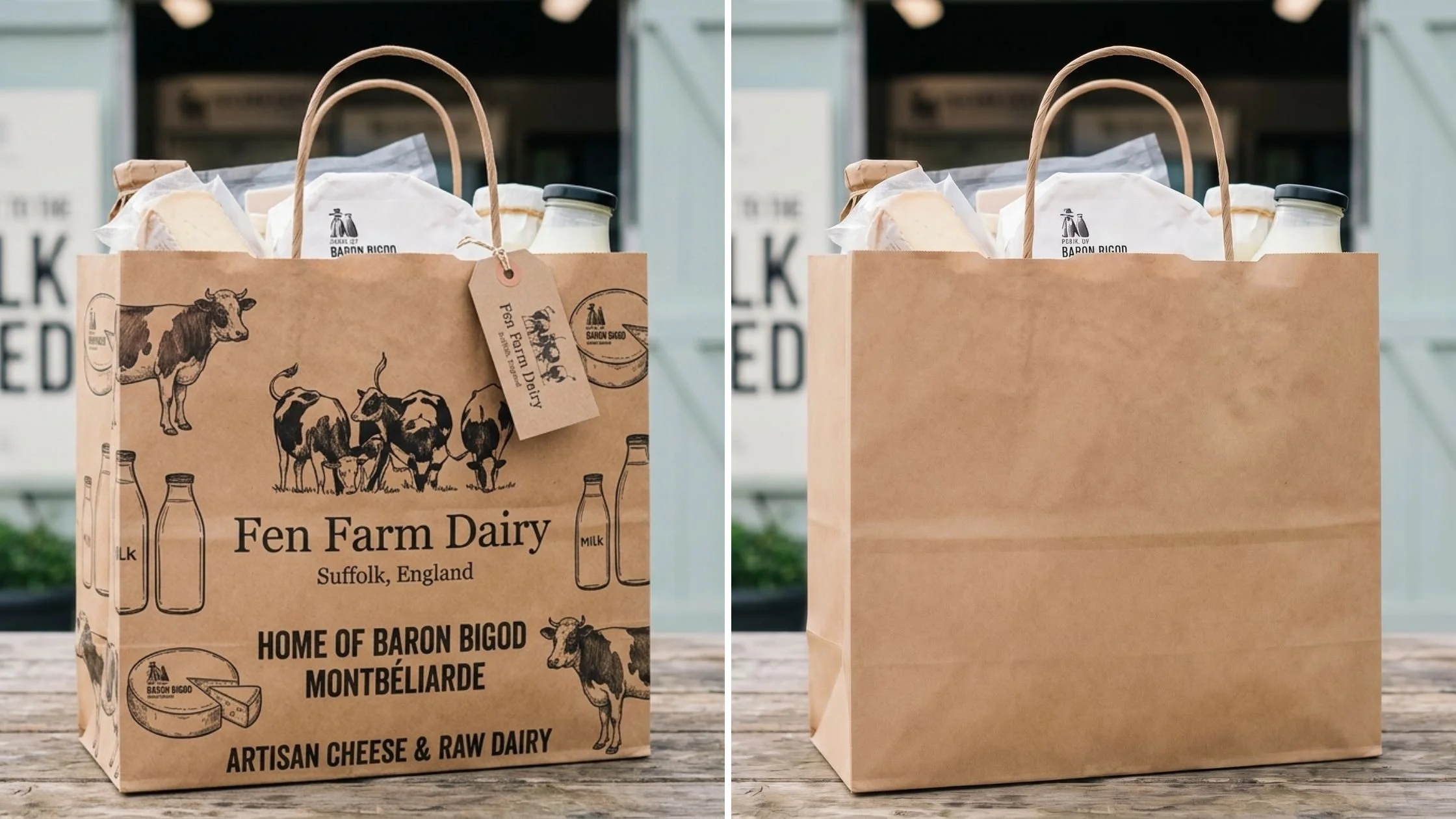
Most independent businesses put serious thought into their brand. The shopfront, the product, the labels, the Instagram feed - all of it considered and deliberate. And then customers leave with a bag that undoes some of that work.
It is rarely a conscious choice. It is usually just the path of least resistance: the bags that were easiest to order, or cheapest, or available at short notice. But packaging is the last thing a customer touches on their way out of your shop, and the thing they carry through town afterwards. It deserves the same attention as everything else.
Here are five mistakes we see regularly - and what to do about each one.
1. Using a stock bag with an overprinted logo
The most common one. An overprinted stock bag is a bag that already exists - a standard size, a standard shape, a standard paper weight - with your logo applied on top. The overprinting is usually in one colour, often slightly off-register, and the result is a bag that looks like what it is: a generic bag that has been stamped.
The problem is not that it carries your logo. It is that the bag itself communicates something about your standards before anyone reads the logo. A flimsy stock bag with a slightly wonky print says something different to a bag that has been made to your specification, in your paper weight, with your artwork reproduced properly.
The fix is a genuinely custom bag - manufactured to your spec rather than overprinted onto someone else's. At 1,000 units the price difference is more modest than most businesses expect, and the difference in how the bag looks and feels is immediate.
2. Submitting a low-resolution logo
A logo saved from a website, screenshotted from a social profile, or scaled up from a business card will not reproduce well at bag scale. The pixelation that is invisible on a small label becomes obvious on a bag that is 30 or 40 centimetres tall.
Print requires vector artwork - typically an AI, EPS, or PDF file from the designer who originally created your logo. If you had your branding done professionally, those files exist. If you cannot find them, go back to whoever made them and ask for the original source files. That is a reasonable request and any reputable designer will have kept them.
If your branding was put together informally and original vector files do not exist, it is worth having a designer recreate them before you commit to a bag order. A logo reproduced from a low-quality file will look poor on anything printed at scale, not just bags - so sorting it out properly is worthwhile regardless.
3. Choosing the wrong size
A bag that is too large for your product looks careless. The product rattles around, tissue paper is needed to fill the void, and the whole thing feels under-considered. A bag that is too small forces the product in at an awkward angle or does not close properly.
Getting the size right requires actually measuring your most common products and thinking about how they sit in a bag - upright, flat, stacked. Most businesses have one or two product shapes that account for the majority of their bag use, and those should drive the specification.
It is also worth thinking about gusset depth - the front-to-back dimension of the bag - which is the measurement most often overlooked. A bag can be the right height and width but too shallow to sit properly with a boxed product inside.
If you are unsure, this is exactly the kind of thing to talk through before you order. Getting a sample bag and physically putting your product inside it takes thirty seconds and removes all ambiguity.
4. Printing too small, or too much
Both directions cause problems.
Printing too small means your branding disappears at any distance. A logo that reads well on a business card becomes a postage stamp on a bag. The artwork that works in digital contexts often needs to be scaled up significantly to work on packaging - and sometimes simplified too, since fine detail that looks sharp on screen can fill in or bleed slightly in print.
Printing too much is the other failure mode. Some businesses treat the bag as an opportunity to put everything on it - the logo, the website, the phone number, the social handles, the tagline, the address - and the result is cluttered and hard to read. A bag is not a leaflet. The most effective branded bags tend to be restrained: one dominant element, reproduced well, at a size that commands attention.
The rule of thumb is that someone five metres away should be able to read your name on your bag without squinting. Test your artwork at actual size before you approve a proof.
5. Treating the bag as an afterthought
This is the underlying mistake behind all the others. Packaging tends to get sorted at the end of a project - after the shopfit, the product, the website, the signage - when the budget is tighter and the decision gets made quickly.
The result is a bag chosen for availability rather than fit. And because bags are reordered on autopilot once the first batch runs out, a poor first choice tends to persist for years.
The businesses whose packaging works best are the ones who thought about it alongside everything else - who asked "what does this bag say about us?" with the same rigour they applied to the rest of the brand. That is not a complicated question, and it does not require a big budget. It just requires treating the bag as part of the brand rather than a logistical necessity.
If any of this resonates and you would like to talk through your current packaging or a new bag specification, we are happy to have that conversation. No pressure, no obligation - just a practical discussion about what would work for your business.
Get in touch here.
Your brand. Your bag. Made in Britain.
British Bag Co supplies custom-branded paper bags to independent retailers, food businesses, farm shops, and cafés across the UK. From 1,000 units. UK-manufactured. FSC and PEFC certified paper. Visit www.britishbags.co.uk.
